Also known as:
Golden-fronted Hanging Parrot, Misool Hanging Parrot, Papuan Hanging Parrot, Bat Lorikeet
Also known as:
Golden-fronted Hanging Parrot, Misool Hanging Parrot, Papuan Hanging Parrot, Bat Lorikeet
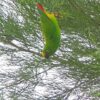
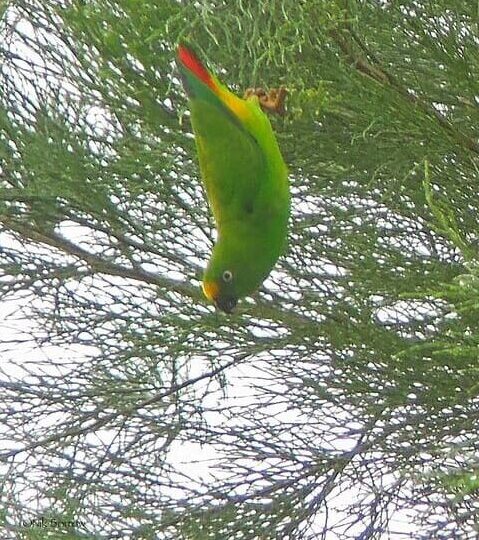
The Orange-fronted Hanging Parrot runs its beak along casuarina needles and twigs, apparently searching for lerp (sugar-filled) insects.

Loriculus

aurantiifrons
Size:
10 cm (4 in)
Weight:
13-16 g (0.4-0.5 oz)
Subspecies including nominate:
three: L.a. aurantiifrons, L.a. batavorum, L.a. meeki
Colour Adult:
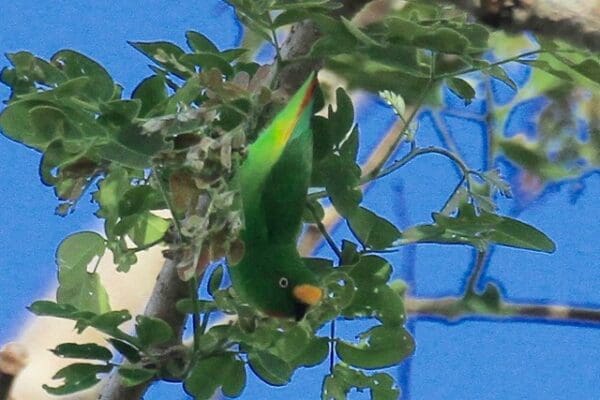
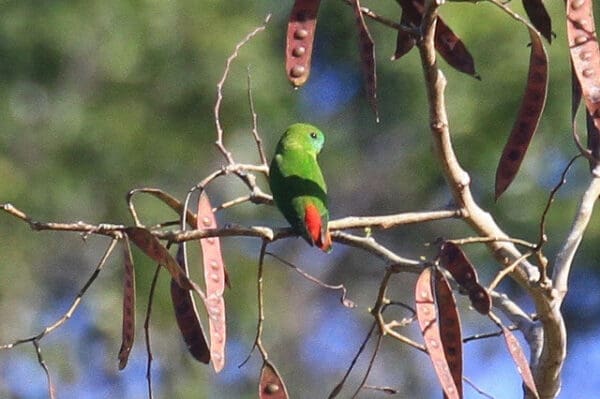
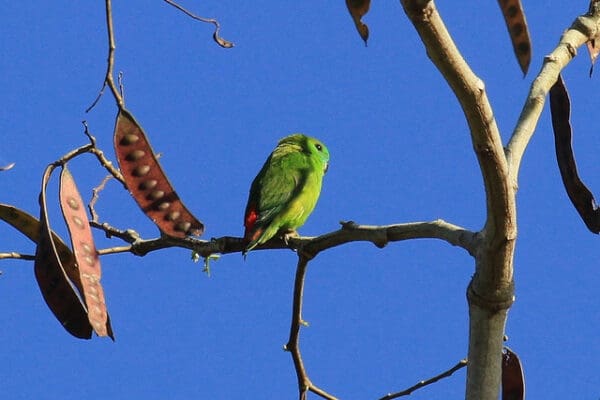
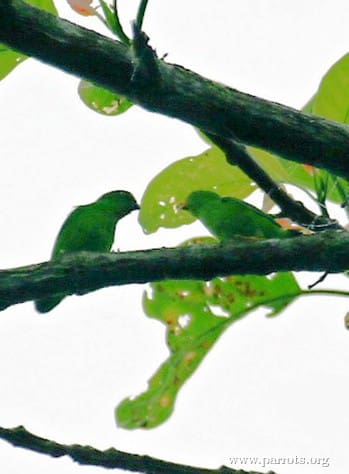
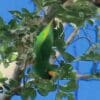
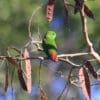
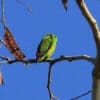
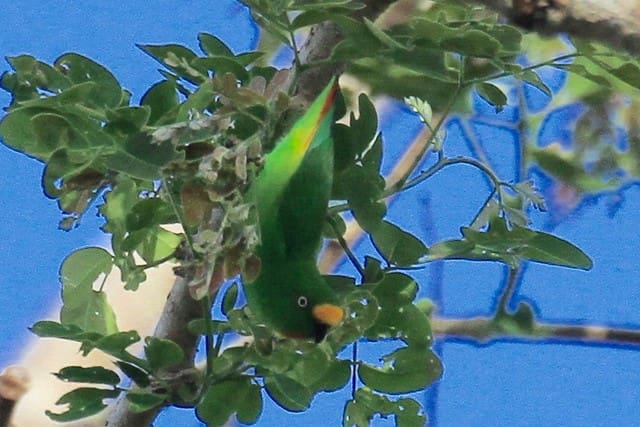
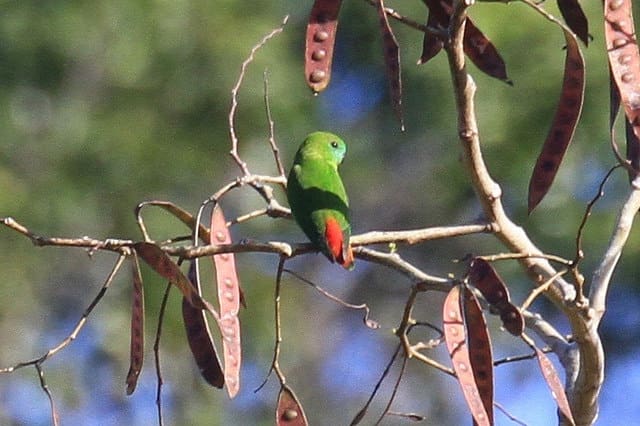
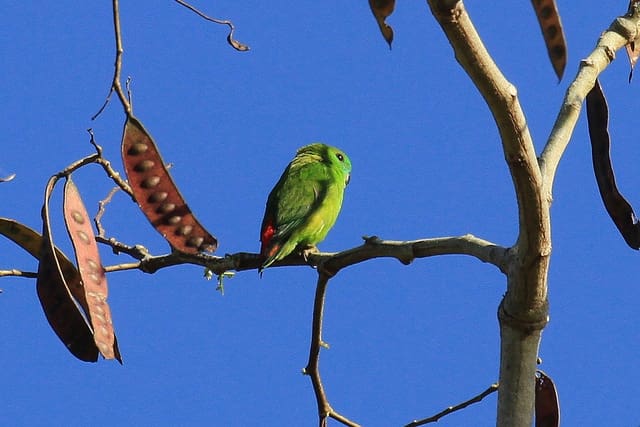
L.a. aurantiifrons: Male-mainly green in colour; golden/yellow forehead and forecrown; patch on throat red; red rump and upper tail coverts; yellow on sides of rump; green tail tipped with yellow/green. Beak black. Eye yellow/white. Female-blue/green forehead and forecrown; blue wash on cheeks; red patch on throat smaller. Eye brown.
L.a. batavorum: Both adults as in aurantiifrons, but male has less yellow on forehead and forecrown.
L.a. meeki: Both adults as in batavorum, but slightly larger; in female, bases of forecrown feathers paler yellow/brown.
Colour Juvenile:
L.a. aurantiifrons: As in adult female, but red patch on throat absent. Beak pale brown.
Call:
Calls are described as shrill and rapidly repeated, sometimes lengthened into song; also buzzing notes while perched.
More Information:
Content Sources:
CITES
BirdLife International
Cornell Lab of Ornithology/Birds of the World
Parrots: A Guide to Parrots of the World, Juniper and Parr, 1998
Parrots of the World, Forshaw, 2006. 2010 edition
Parrots in Aviculture, Low, 1992.
Lexicon of Parrots, Thomas Arndt.
Captive Status:
Extremely rare.
Longevity:
—
Housing:
Aviary indoors 2.5 x 1 x 2 m (8.2 x 3.3 x 6.5 ft), new birds no less than 25 C (77 F). Strict hygiene necessary.
Diet:
Fruits such as: figs, pear, apple, banana, oranges, cactus fruits; vegetables such as: carrot, celery, green beans and peas in the pod; lory nectar made from: lactose-free baby cereal, honey, molasses or malt extract, and filtered water, made fresh once or twice daily, or commercial nectar; fruit tree (unsprayed) branches with blossoms; small quantities of seed mix of: millet, canary seed, some niger and oats (may be sprouted); millet spray (sprouted).
Enrichment:
Provide plenty of bird-safe, unsprayed flowering branches.
Nest Box Size:
—
Clutch Size:
4
Fledging Age:
—
Hatch Weight:
—
Peak Weight:
—
Weaning Weight:
—
World Population:
Unknown, decreasing.
IUCN Red List Status:
Least Concern
CITES Listing:
Appendix II
Threat Summary:
Not globally threatened. Is reported as locally common. Is considered to have a medium dependency on forest habitat, and tree cover is estimated to have declined by 2.2% within its range over the past 10 years. It is tentatively suspected that this may have led to a 1-19% decline in the species’ population over the same period.
Range:
L.a. aurantiifrons: Misool, West Papuan islands, Indonesia.
L.a. batavorum: Waigeu, West Papuan islands, and northwestern New Guinea, east on north coast to Sepik River region, northern Papua New Guinea, and on the south coast to Setekwa River, West Papua.
L.a. meeki: Fergusson, Goodenough, and Karkar Islands, Papua New Guinea, and eastern New Guinea, on the north coast, west to the Sepik River region, and in the southern lowlands west to Fly River region.
Habitat:
Rarely found up to 1200 m (3936 ft), rarely 1600 m (5248 ft); more commonly up to 300 m (984 ft) in lowland rainforest, along forest edge, in palm plantations, secondary growth, casuarinas, pines, gardens, and partly cleared areas.
Wild Diet:
Feeds on buds, fruits, flowers, nectar and sugary psyllid lerps. Possibly seeds.
Ecology and Behaviour:
Not easily seen as it forages in various levels of the canopy. Courtship behaviour may include perching on exposed branches and singing to attract attention. Usually found in groups of 2-4.
Clutch and Egg Size:
Up to 4 eggs.
Breeding Season:
September-October; nest is in small hollow in narrow tree.
Related Links:
—